Free proxy lists vs paid proxies: why scraped lists fail
Where free proxy lists come from, why most of their proxies are dead or unsafe, what 'premium proxy lists' really are, and when a free proxy is good enough.
ZenProxy team · 8 November 2026 · 10 min read
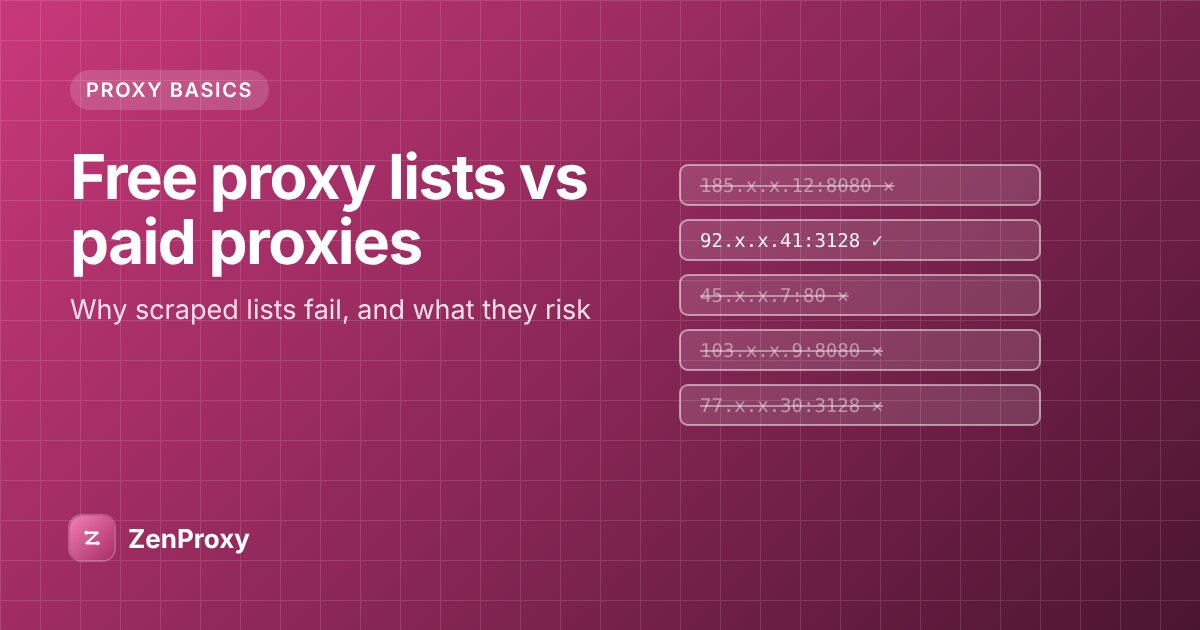
In short: A free proxy list is a scraped collection of open proxies: servers that relay traffic for anyone, with no password, run by people you can't identify. Most are dead by the time you try them (one study found more than 92% of listed proxies unresponsive), and a measurable share inject ads, track you, tamper with downloads or intercept HTTPS. Many "premium proxy lists" are the same open proxies, checked more recently. A paid proxy gives you a login, a named operator and a refund policy, so keep free lists for learning and for tests where nothing sensitive is sent.
Where free proxy lists come from
A free proxy list is a web page or text file of IP:port lines. Each line is an open proxy: a server that relays traffic for anyone who connects, without asking for a username or password.
What "proxy scraper sources" are
A proxy scraper downloads lists like these from many places, merges them and tests each address. Its "sources" are the URLs it pulls from: proxy aggregator websites and public code repositories that publish proxy files. ProxyBroker, an open-source tool of this kind, says it finds proxies "from ~50 sources".
Two studies built lists the same way and tested them. Mani et al. (Georgetown and Northeastern universities, 2018) studied more than 107,000 listed open proxies over 50 days. Tsirantonakis et al. (NDSS 2018) monitored 15 proxy-list websites for two months and collected 65,871 proxies.
Who runs the proxies on those lists
- Proxies run on purpose. The NDSS paper notes how easy it is to set one up on a cloud server and register it on proxy-list websites. Mani et al. suggest some operators do it as a statement about privacy. Others profit: the NDSS authors point out that rogue operators "can monetize their traffic by altering the relayed content".
- Misconfigured servers. A proxy meant for one office or school that accepts connections from anywhere. In Mani et al., four of the 21 certificate issuers seen in intercepted HTTPS connections appeared to be schools, whose proxies the authors think were wrongly configured to serve requests from any network.
- Compromised devices. Mani et al. say some open proxies exist "due to misconfiguration or even compromise". In May 2025 the FBI warned about end-of-life routers infected with variants of TheMoon malware, which "allows cyber actors to install proxies on unsuspecting victim routers".
The supply keeps refilling. About 62% of the working proxies Mani et al. found listened on ports 8080, 3128 or 20183, and they cite Censys reporting 7.3 million hosts on port 8080 and Shodan 1.1 million on port 3128. They treated those hosts only as potential proxies and, for ethical reasons, didn't probe them.
Why free proxies stop working so quickly
- Mani et al. found that "more than 92% of open proxies that appear on aggregator sites are unresponsive to proxy requests". On a median day, only 3,283 proxies answered.
- In the NDSS study, 46.40% of the reachable proxies worked properly on the first day. Two months later, only 23.08% were still working.
The reasons are built into what an open proxy is. Misconfigured servers get locked down and hacked routers get patched or replaced. Many home connections get a new IP from time to time, so a proxy on a home device leaves its listed address. Once published, an address is hit by many scrapers at once, and the NDSS authors note many proxies are slow "mainly due to the high load they have". And everything anyone sends through it, abuse included, comes from one IP, so sites block it.
You spend more time replacing proxies than doing the job.
The security risks of an unknown proxy
A proxy sits in the middle of every connection you send through it. OWASP describes an attacker in that position as one who "acts as a proxy, being able to read, insert and modify the data". With an open proxy, you put a stranger there yourself.
Plain HTTP: the proxy sees and can change everything
For an http:// address, the proxy receives your request and the response in full: the URL, form fields, cookies, and any username and password you type. It can log all of it and change the page before you see it.
In the NDSS study, 38% of the working proxies tested modified content in some way, often harmlessly (some were privacy proxies that strip trackers and ads). But "5.15% of the tested proxies were found to perform modification or injection that can be considered as malicious or unwanted". Of those, 47% injected ads, 39% injected code that collects information for tracking and fingerprinting, and 12% tried to redirect users to pages containing malware.
Mani et al. found injected ads, cryptocurrency-mining scripts and files altered in transit: 1.93% of the proxies they tested (413 of 21,385) maliciously modified a Windows executable at least once.
HTTPS: safer, unless you click through a warning
For an https:// address, your client asks the proxy to open a tunnel with a CONNECT request. From then on, the HTTP standard says the proxy should restrict itself to "blind forwarding of data, in both directions". It still sees your real IP address and the hostname you connect to, but not the pages or what you type.
The attack that's left is a fake certificate. Mani et al. found that "1.06% (102/9,625) of proxies that support HTTPS perform TLS/SSL MitM by inserting a modified certificate". Your browser or HTTP library warns you when that happens. If you click through, or switch off checks with verify=False in Python or -k in curl, the proxy can read everything, logins included.
Logins, keys and downloads
Treat anything you send through a free proxy as public. Don't sign in to accounts or send cookies, tokens or API keys, keep certificate checks on, and don't download files you plan to open. Assume the operator logs your real IP and every hostname you visit.
The legal and ethical problem
An open proxy has an owner who often never agreed to carry your traffic. They pay for the bandwidth, and abuse reports and blocks land on their IP. If the device was hacked, you're riding on a crime against its owner.
Many countries make unauthorised use of a computer an offence. In the UK, section 1 of the Computer Misuse Act 1990 covers causing a computer to perform a function to secure access you know is unauthorised. Whether using a stranger's open proxy falls under a law like this depends on the country and on what you knew, and this isn't legal advice. But an address on a public list is not permission from its owner.
What "premium proxy lists" usually are
Search "buy proxy list premium" and you'll find sellers of proxy files and feeds. Look at what the lines contain:
IP:portwith no username or password. These are open proxies. Anyone can use them, so the seller can't stop them dying or tampering with traffic. You're paying for a more recent check, and you inherit every risk above.host:port:username:passwordfrom a named company. That's access to a real proxy service: the login means someone controls who uses it. Judge it like any provider.- Cheap "residential" access from a seller with no company name, terms or refund policy. Be careful. The FBI has warned about criminal proxy services that exploit hacked end-of-life routers.
What a paid proxy gives you instead
| Free list | "Premium" list of open proxies | Paid proxy provider | |
|---|---|---|---|
| Login | None | None | Username and password on every line |
| Who runs it | Unknown | Unknown; the seller doesn't control it | A named company with published terms |
| How many work | A minority | Checked more recently, same proxies | Working lines are what you pay for |
| Tampering risk | Measured in studies | Same proxies, same risk | Accountable operator; still use HTTPS |
| Location | Whatever is listed | Same | Your choice of country, and on some products state, city or ISP |
| Refunds | None | Depends on the seller | A written refund policy |
At ZenProxy, that means:
- Authentication. Every line has a username and password, so only someone with your login can use it.
- A choice of IP type. Residential Lite with country targeting for sites that expect home visitors, and static datacenter IPs for sites that accept server traffic.
- Refunds. If your proxies don't work because of a problem on our side and we can't fix it within 48 hours, we refund the unused part of the plan. We don't refund because a site blocks the proxies, so test on your target with a small plan first. Details are in our refund policy.
- A small first order. Residential Lite sells from 1 GB, usable for 180 days, and Static Datacenter is sold by the IP (current prices on the plans page). Proxies are set up automatically once the payment is confirmed.
A caveat: a paid proxy is still a third party, and any proxy, ours included, carries plain-HTTP traffic in readable form. Use HTTPS and keep certificate checks on, and you don't have to trust any proxy with your content.
Before you rely on a paid line, paste it into our free proxy checker. It tests one HTTP proxy, shows whether it connects, its exit IP, location, network and response time, and stores nothing you paste.
When a free proxy is fine
- Learning how proxies work. Watching your exit IP change or seeing a 407 error. The safest way is a proxy you run yourself, on your own computer or a cloud server you rent: free, and nobody else's device.
- Quick, harmless tests on public pages. If you do use a public list, stick to public pages over HTTPS with certificate checks on, no login and no cookies, at a gentle rate.
- Free browsing privacy. If you want anonymity rather than a choice of country, Tor is the better free option: Mani et al. found "no instances in which Tor relays performed TLS MitM or manipulated content".
For anything with a login, a deadline or a customer attached, a free list costs more than it saves. For data collection, proxies for web scraping covers which proxy type suits which site.
Questions people ask
Are free proxy lists safe to use?
Not for anything that matters. In the NDSS study, about 1 in 20 working proxies made malicious or unwanted changes to pages, and Mani et al. found about 1% of HTTPS-capable proxies using fake certificates. You can't tell which in advance.
Why do free proxies stop working so fast?
Nobody is responsible for keeping them up. Misconfigured servers get fixed, hacked devices get cleaned, home IPs change, and published proxies get overloaded and blocked.
What are proxy scraper sources?
The URLs a proxy scraper downloads lists from, such as aggregator websites and public repositories of proxy files. Whatever the source, you get open proxies: most dead, some hostile.
Is it worth buying a premium proxy list?
Not if it's plain IP:port lines without a login: those are open proxies the seller doesn't control. Access to a proxy network with your own username and password, a named operator and a refund policy is a different product. At ZenProxy, Residential Lite sells from 1 GB; see plans for the current price.
What should I look for in a paid proxy provider?
A named company with published terms and a refund policy, a login on every line, a choice of country and IP type, and a way to reach a person. Then test on a small plan before you scale.
Is it illegal to use a free proxy?
It depends on where you are and whose proxy it is. A proxy run publicly on purpose differs from a misconfigured or hacked device whose owner never agreed. Laws on unauthorised computer use are broad, so take legal advice if it matters.
Sources
- Mani, Vaidya, Dworken and Sherr: An Extensive Evaluation of the Internet's Open Proxies (arXiv, 2018)
- Tsirantonakis, Ilia, Ioannidis, Athanasopoulos and Polychronakis: A Large-scale Analysis of Content Modification by Open HTTP Proxies (NDSS 2018)
- FBI IC3: Cyber Criminal Proxy Services Exploiting End of Life Routers (7 May 2025)
- OWASP: Manipulator-in-the-middle attack
- RFC 9110: HTTP Semantics, section 9.3.6 (CONNECT)
- Computer Misuse Act 1990, section 1
- ProxyBroker on GitHub